Banksy’s Provocative London Statue Unveiled: A Masterstroke of Social Commentary

Editor 01 May, 2026 ... min lectura

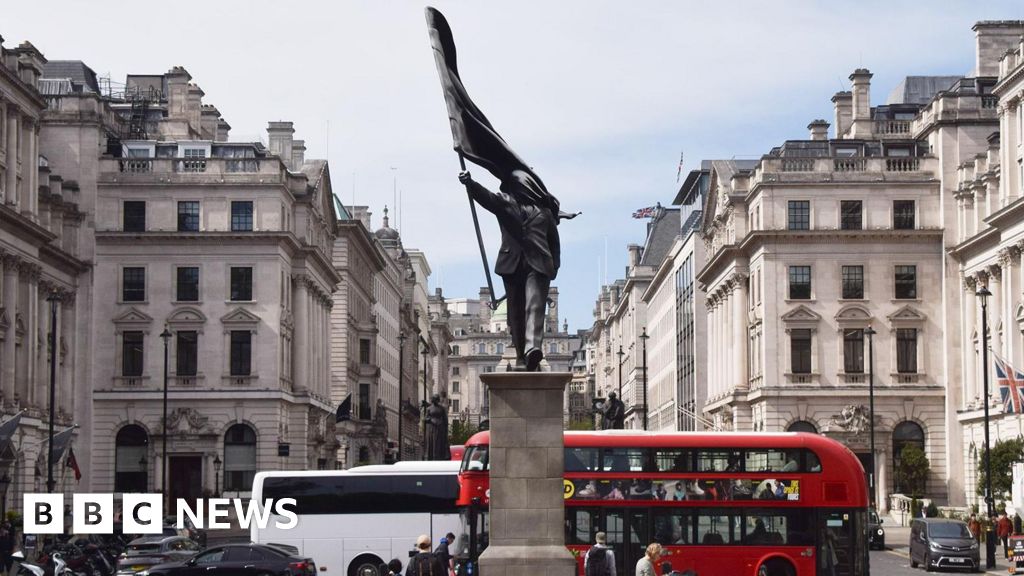
London’s streets have long been a canvas for artistic rebellion, and Banksy’s latest contribution to the city’s cultural landscape has sent ripples through both the art world and the public consciousness. The artist, known for his bold, politically charged street art, has once again pushed boundaries with a striking new installation in the heart of the city. A towering statue depicting a man blinded by a flag has been revealed as his creation, unveiled at Waterloo Place in central London. This piece, described as a 'satire on blind patriotism,' immediately sparked widespread discussion about the intersection of art, politics, and national identity.

What does Banksy’s statue mean?

The artwork, which measures over 1.5 meters in height and features a man with one eye covered by a flag, has been interpreted as a critique of how national symbols and flags are often treated as unquestioned truths. Banksy has not explicitly detailed the symbolism, but the imagery aligns with his history of using visual metaphors to challenge societal norms. The artist’s previous works, such as his iconic 'Girl with Balloon' and 'Dying Aerial' series, often highlight themes of political corruption and social inequality, making this piece a natural evolution of his critical perspective.

While the public has been quick to praise the statue’s boldness, critics have questioned the potential for misinterpretation. Some argue that the flag’s role in the piece could be seen as a direct commentary on the United Kingdom’s role in global conflicts, particularly its historical involvement in military interventions and the consequences of its actions abroad. Others suggest the piece is a subtle nod to the complexities of national identity in a post-Brexit world, where the concept of 'Britishness' has become increasingly contested.

  • The statue’s placement in Waterloo Place—a historically significant location associated with London’s political and social history—adds layers of meaning to the work.
  • Banksy’s use of the flag as a visual metaphor for the loss of sight in the face of ideological rigidity has been compared to his earlier works, such as 'The Protest' series.
  • Local authorities have been cautious about the statue’s message, noting that it challenges the public to reflect on the consequences of blind allegiance to national symbols.

The artist’s decision to place the statue in a public space, rather than in a traditional gallery, underscores his commitment to the street art movement. Unlike conventional artists who rely on institutional spaces, Banksy has always prioritized the public sphere as a platform for dialogue, a strategy that has helped him gain global recognition and influence.

Despite the controversy, the statue has been praised for its ability to engage the public in critical thinking. It serves as a reminder that art can be a powerful tool for social commentary, challenging viewers to question their assumptions and consider the broader implications of political and social issues.